
Finding Highland Park Residents
Begin with the record tied most closely to the question. An address belongs first in the Lake County assessor and parcel map. A current owner's name can then move into the Recording Division's deed index. A person's name in a civic or court matter belongs in the City Community Portal, the Nineteenth Circuit eCourt system, or a tightly drawn Illinois Freedom of Information Act request. For an older name, Highland Park Public Library has telephone books, newspapers, obituaries, maps, and local files that reach far beyond a modern web search.
No public roll is a full list of everyone in a home. The tax roll identifies the taxpayer or owner, not each occupant. Voter Power confirms one voter only when the required personal details are supplied. Deeds identify parties to an instrument, while a court result identifies a role in a case. Keep those limits visible at every step.
- Put a street address, owner name, or PIN into the Lake County property search, using one main key at a time.
- Check the parcel card and GIS map for situs address, taxpayer mailing address, municipality, and parcel context.
- Search the recorder by grantor, grantee, PIN, city, document type, or legal description, then inspect the image.
- For a historic person, compare directory years with newspaper, obituary, map, and deed dates.
- When an index is absent, ask the correct custodian for a narrow record under Illinois FOIA or the record-specific process.
Highland Park Records Custodians
Highland Park is in Lake County, and Waukegan is the county seat. That split matters. City Hall keeps municipal permits, council material, ordinances, and City department files. The county keeps deeds, parcel assessments, elections, vital records, and circuit court files. The Illinois agencies add statewide archives, licenses, business entities, custody status, registries, and unclaimed property. A Highland Park residents directory search works best when the request goes straight to the office that created the record.
Lake County Recording Division
18 N County Street, 6th Floor
Waukegan, IL 60085
847-377-2575
Chief County Assessor
18 N County Street
Waukegan, IL 60085
847-377-2050
Lake County Clerk Elections
18 N County Street, Room 101
Waukegan, IL 60085
847-377-2410
Highland Park Property Search
The assessor offers both a Basic Search and an Advanced Search. Basic Search tells users to choose one main key: parcel ID, owner, billing name, or address. Owner names use the form LastName, FirstName, and an asterisk works as a wildcard. Address fields separate number, direction, street, suffix, unit, city, and ZIP. That structure helps when a street has directional forms or a unit number.
The advanced portal can combine owner, street, ZIP, municipality, township, sale dates, year built, property class, school or tax district, and physical traits. Results may be sorted by parcel, owner, or address. Current and deactivated parcels can be separated. This is useful for a Highland Park residents directory search, but the county bars data mining and gives no warranty that a tax record proves occupancy.
| Field | How to use it |
|---|---|
| Parcel ID | Enter the PIN without dashes for the most exact match. |
| Owner | Use LastName, FirstName, or a careful wildcard. |
| Address | Split number, direction, street, suffix, unit, city, and ZIP. |
| Township | Check Moraine or West Deerfield where the parcel context calls for it. |
| Advanced criteria | Combine geography, sale, class, district, and building fields. |
The Lake County assessor search shown here exposes the one-key form used for the first match.
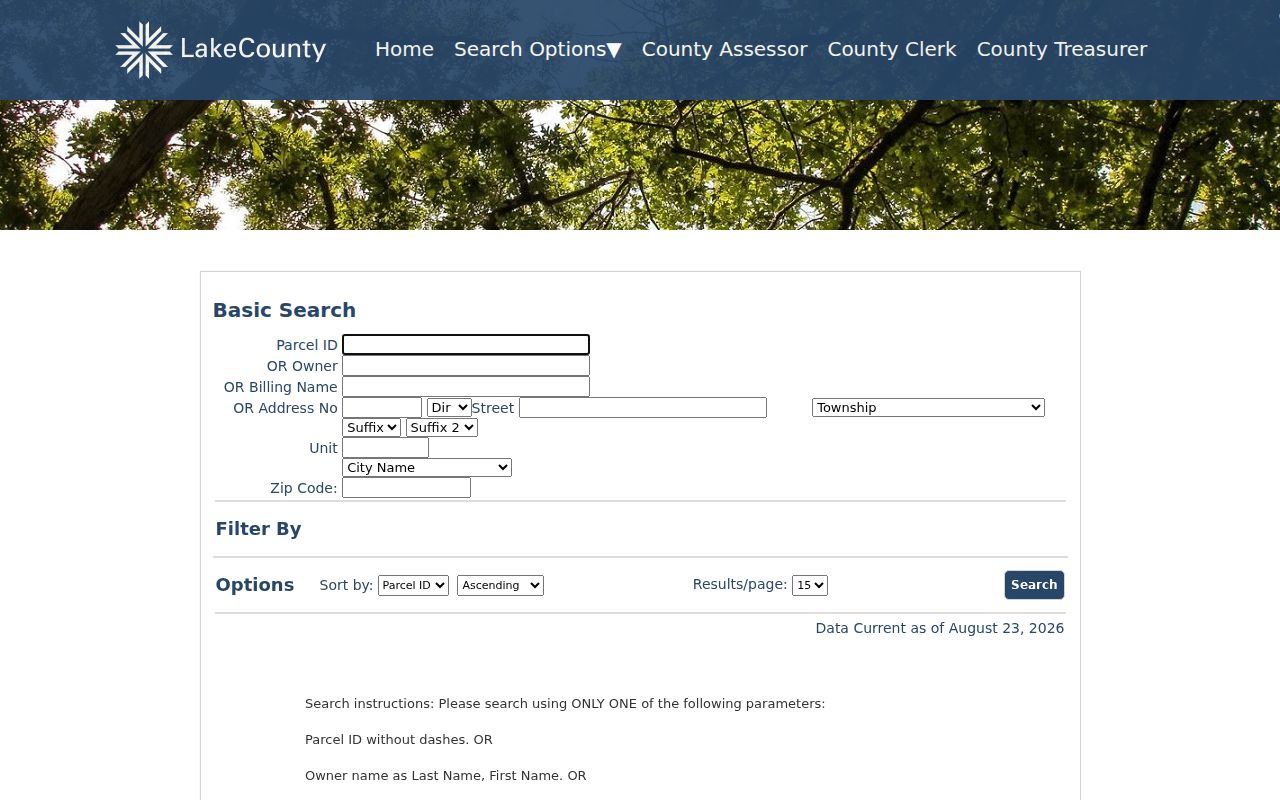
The form makes clear why an address, owner, and parcel number should be tested separately rather than packed into one query.
Highland Park Deed Index
The Lake County Official Records portal is the legal-document half of the property trail. Quick Search accepts a broad term, a date range, and either index-only or index-plus-OCR text. Advanced Search adds grantor or grantee role, PIN, city, township, lot, block, section, legal description, document number, sale date, and document type. Deeds, mortgages, liens, releases, plats, surveys, easements, covenants, foreclosure instruments, and UCC filings sit in distinct groups.
Observed online coverage begins January 2, 1980. Earlier ownership is not lost by default. It moves to handwritten grantor and grantee index books, then to the underlying deed image or book. The county warns that recording is a two-step process and staff do not complete title searches. Copy the exact party spelling, role, instrument number, recording date, legal description, PIN if present, and any prior reference.
- Index
- A finding aid that points to a record; it is not always the full document.
- Grantor
- The party transferring an interest.
- Grantee
- The party receiving an interest.
- Parcel
- A mapped tract with a county property index number.
The recorded-land Quick Search is the current starting screen for Highland Park instruments.
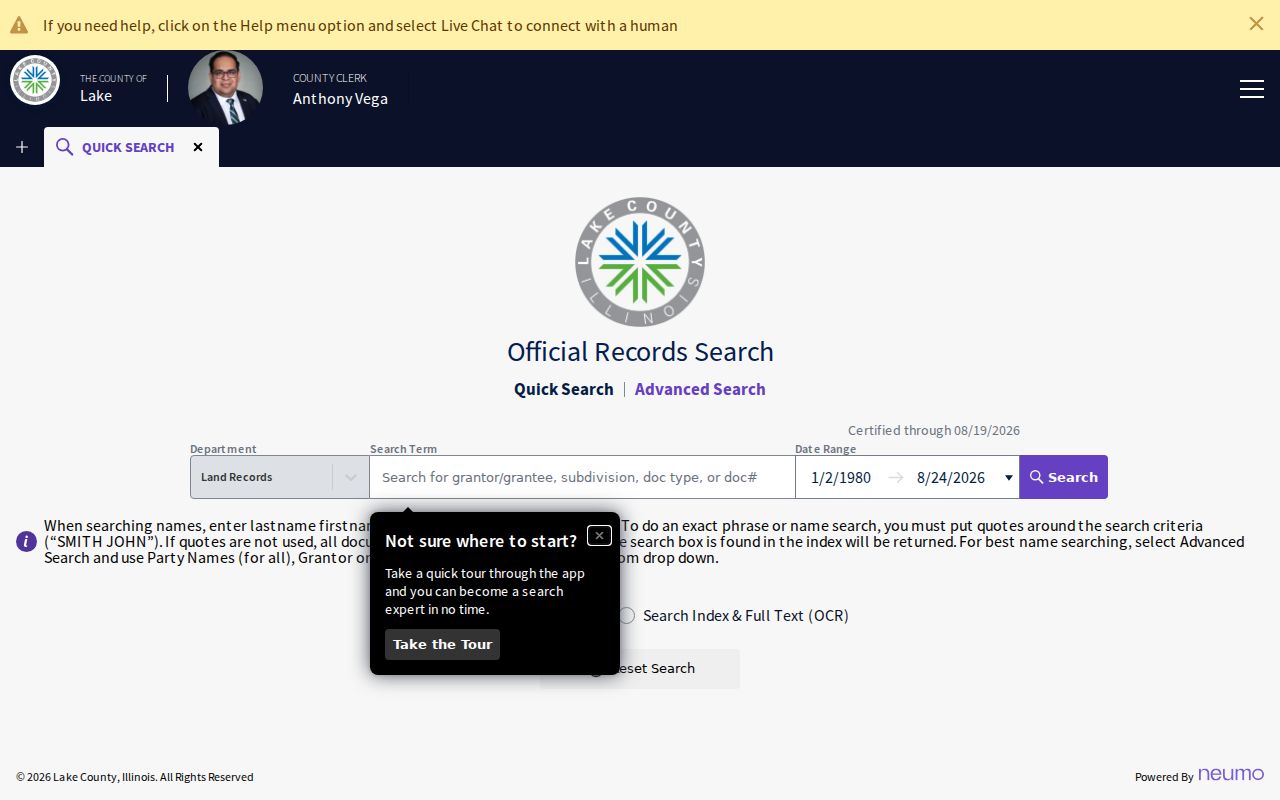
The date controls and OCR choice show how a name search can be narrowed before the actual instrument is checked.
Current Highland Park Resident Rolls
Modern records list people because they own land, registered to vote, signed a document, appeared in a public case, or acted for a business. None is a full household list. The table separates the role each source can prove. For one named person, the Highland Park resident lookup gives the more focused cross-check process.
| Source | Who It Lists | Keeper | Access |
|---|---|---|---|
| Property Tax Information | Owners or taxpayers tied to parcels | Chief County Assessor | Free public portal |
| Voter Power | One registered voter | Lake County Clerk | Authenticated individual check |
| Official Records | Parties to recorded instruments | Recording Division | Index online; image terms vary |
| eCourt Public Portal | Public parties and case roles | Circuit Clerk | Summary online; restricted files omitted |
| City permit inquiry | Applicants and recorded owners on projects | Highland Park | Public inquiry; deeper access may need account |
A parcel result can support an ownership link. A deed can show a transfer. A voter result can confirm registration and polling details for the person who supplies the needed information. A permit dates a project, not residence. A case name must be read with its role and date. These are complementary facts, not interchangeable claims.
Highland Park Voter Confirmation
Lake County Voter Power is built for individual confirmation. It uses a name, house number, ZIP, and date of birth, then can return registration status, district and elected-official context, polling place, ballot, and voting-history information. It is not a way to browse everyone on a block. The larger electronic voter file follows Illinois Election Code limits and is supplied only through a separate qualifying request and use certification.
Commercial solicitation and business use of Illinois voter data are prohibited. Sensitive identifiers are not exposed. Those limits make voter confirmation a narrow final check when a person is checking their own registration or has the proper details and lawful reason, not the first step in a broad Highland Park residents directory search.
Use public records for lawful personal, family, property, or civic research. Never use a directory result to stalk, harass, or harm anyone.
Lake County Voter Power provides the official confirmation route.
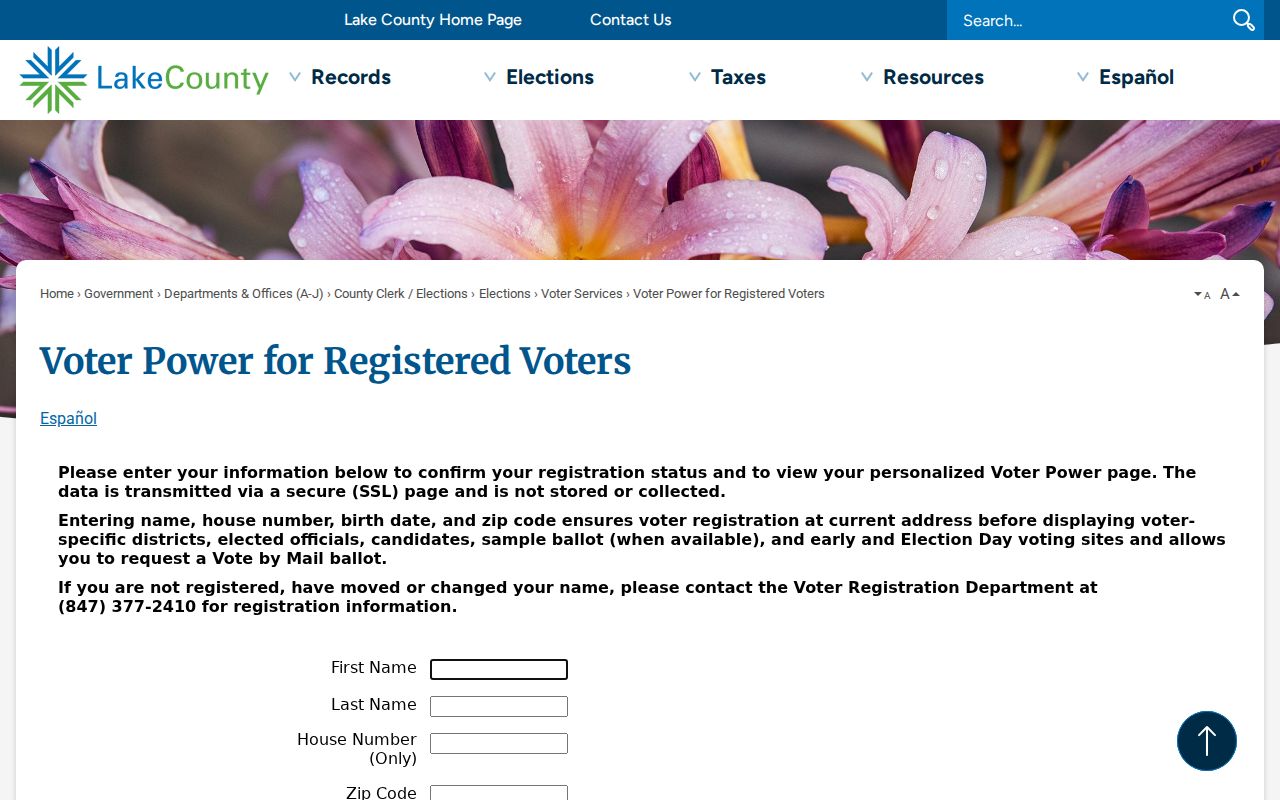
The official screen reinforces that voter confirmation is about one authenticated voter, not a public neighborhood roster.
Highland Park Court Names
Ordinary civil, criminal, probate, family, small claims, protection-order, and traffic matters for Highland Park belong to the Nineteenth Judicial Circuit. The Lake County eCourt Public Portal can expose eligible case summaries by person, case number, or calendar. A result may show case number, case name, filing title, category, filing date, role, status, and action. Some document access requires registration.
The online summary is not the official court record. Sealed, expunged, juvenile, adoption, impounded, and other restricted matters do not appear. Older files may require a courthouse terminal or staff retrieval. A mail name search asks for the person's name, years, case type, and other identifying detail when available. Always distinguish plaintiff, defendant, petitioner, respondent, guardian, or estate role before drawing any conclusion.
The Lake County eCourt portal is the current public entry point.
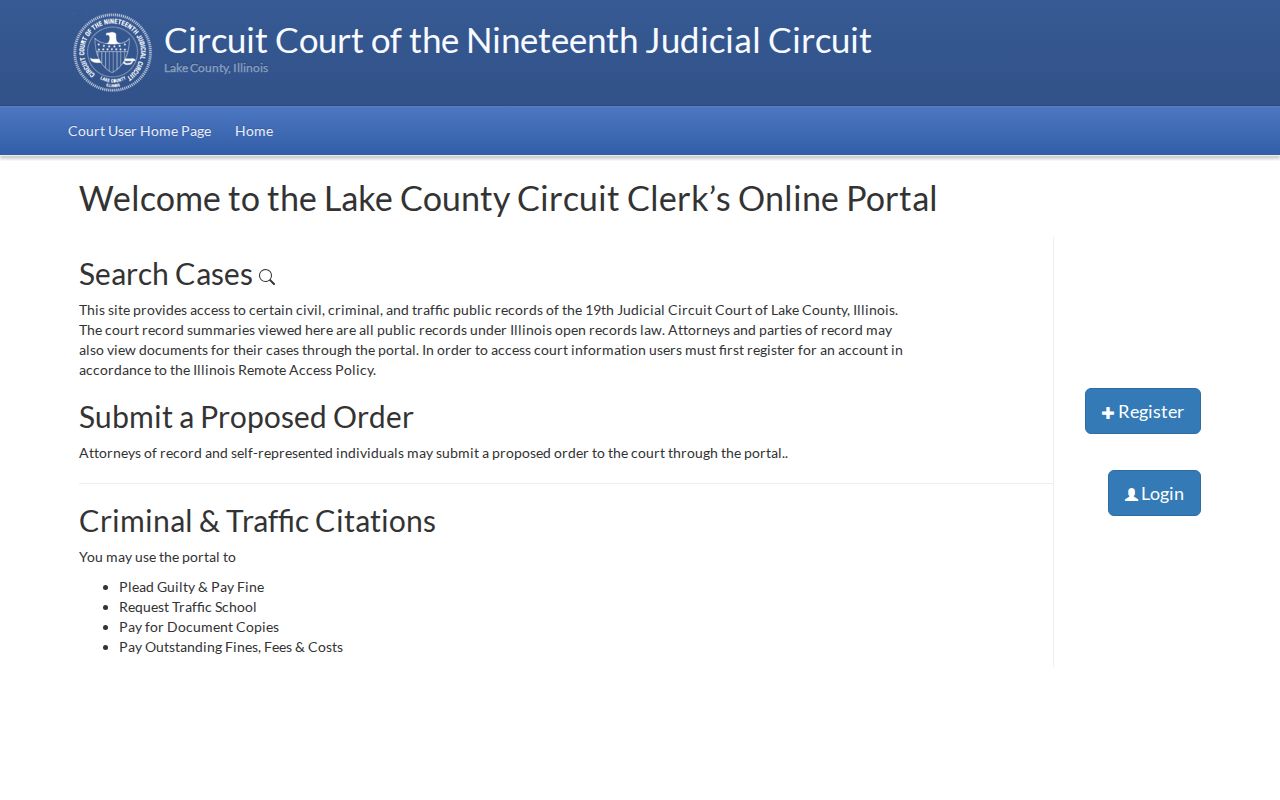
The portal offers a useful lead, while the Circuit Clerk remains the source for a full or certified file.
Highland Park Vital Record Routes
Lake County Clerk Vital Records keeps local birth, death, and marriage records, but access depends on the record and the requester. Recent births are restricted to the named adult, a parent, a proved guardian, or an authorized agent. Death certificates require a qualifying personal or property interest, relationship, or authorization. Divorce decrees belong to the Circuit Clerk, not Vital Records. Adoption originals follow the sealed-record, registry, and confidential-intermediary routes set by Illinois law.
Historical work has a clearer index path. The county genealogy search covers pre-1916 birth, death, and marriage indexes. Genealogy copies generally require a birth to be at least 75 years old or a death to be at least 20 years old. Illinois State Archives and IRAD add Lake County birth series and an early circuit court index. The library obituary index can then connect an event to a newspaper scan and address.
Lake County's Vital Records overview shows the official local service lanes.
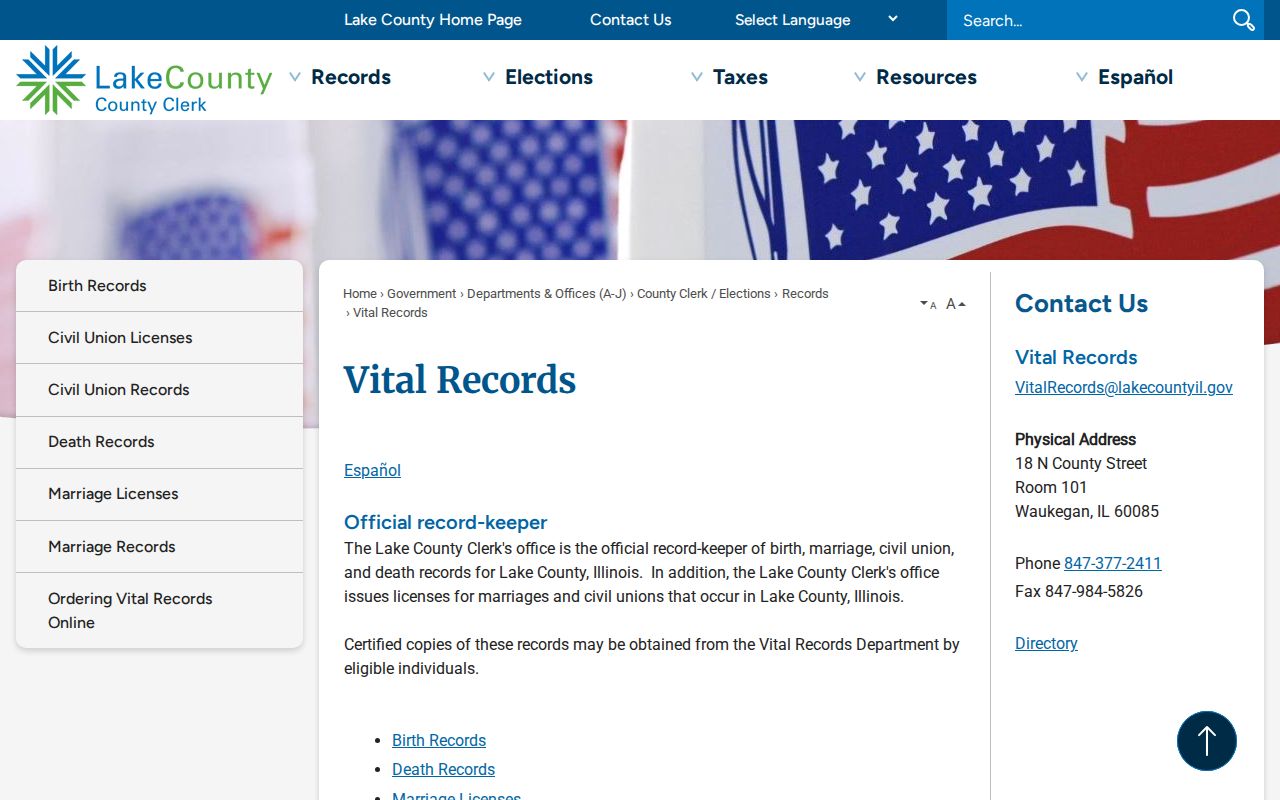
The office page is the right checkpoint for eligibility, forms, identification, and current service details.
Highland Park Address Number Trap
Highland Park renumbered streets in October 1950, and street-name changes followed in 1951. A correct old address may therefore seem to vanish from a current parcel search. The library's Research Your Home guide points to 1919, 1922, and 1951 street directories, tax records from 1906, late-1920s building records, Sanborn maps, and a 1958 Moraine Township house compilation. Newspaper index entries from 1949 through 1951 help bridge public debate and the actual number change.
Write down the old number, new number, street-name form, PIN, subdivision, and evidence date. Legal descriptions are often more stable than house numbers. That small crosswalk prevents two homes from being merged and lets the deed index, directory shelf, map, and permit file meet on the same parcel.
For a full address-led workflow, use the Highland Park street directory.
Note: A modern street number should never be forced onto an older directory entry without a dated local source.
Highland Park Official Sources
Official systems and commercial directory products are not equal. A government index identifies the record keeper, field meaning, access rule, and route to the source image. A commercial compilation may merge stale addresses, unrelated names, and data from unknown dates. It can suggest a lead, but it cannot replace a custodian's record.
| Question | Official record | Commercial category |
|---|---|---|
| Who owns a parcel? | Assessor card and recorded deed | May repeat an old owner without an instrument |
| Was a case filed? | Circuit Clerk summary and official file | May omit role, status, or later order |
| Who used an old address? | Dated directory, map, deed, or newspaper | May merge years and address forms |
| Can a fact be certified? | Custodian copy under record-specific rules | No certification authority |
Keep a research log with the portal name, search term, date searched, exact record date, and image or file reference. That is what turns a loose hit into a checkable Highland Park residents directory result.
Historical Highland Park Directories
The Highland Park Historical Society describes telephone-directory holdings from 1890 through 2014, though the years are not one unbroken run. Highland Park Public Library has digitized local telephone books from 1908 through 1913. Its research guide also identifies broader Highland Park, Waukegan, and Evanston directory material, plus local street directories for 1919, 1922, and 1951. A 1913 entry may label a residence, office, or business separately, so one person can correctly appear at more than one address.
Directories show subscribers or listed householders, not every person in the home. Compare adjacent years, read the abbreviation key, and then test the address against deeds, maps, newspapers, obituaries, and census records. Highland Park Archives & Local History Collections holds family papers, interviews, photographs, maps, government and organization files, and local material from the 1800s forward. Most archive material is used in the library and does not circulate.
The Highland Park archive page explains research access and reproduction.
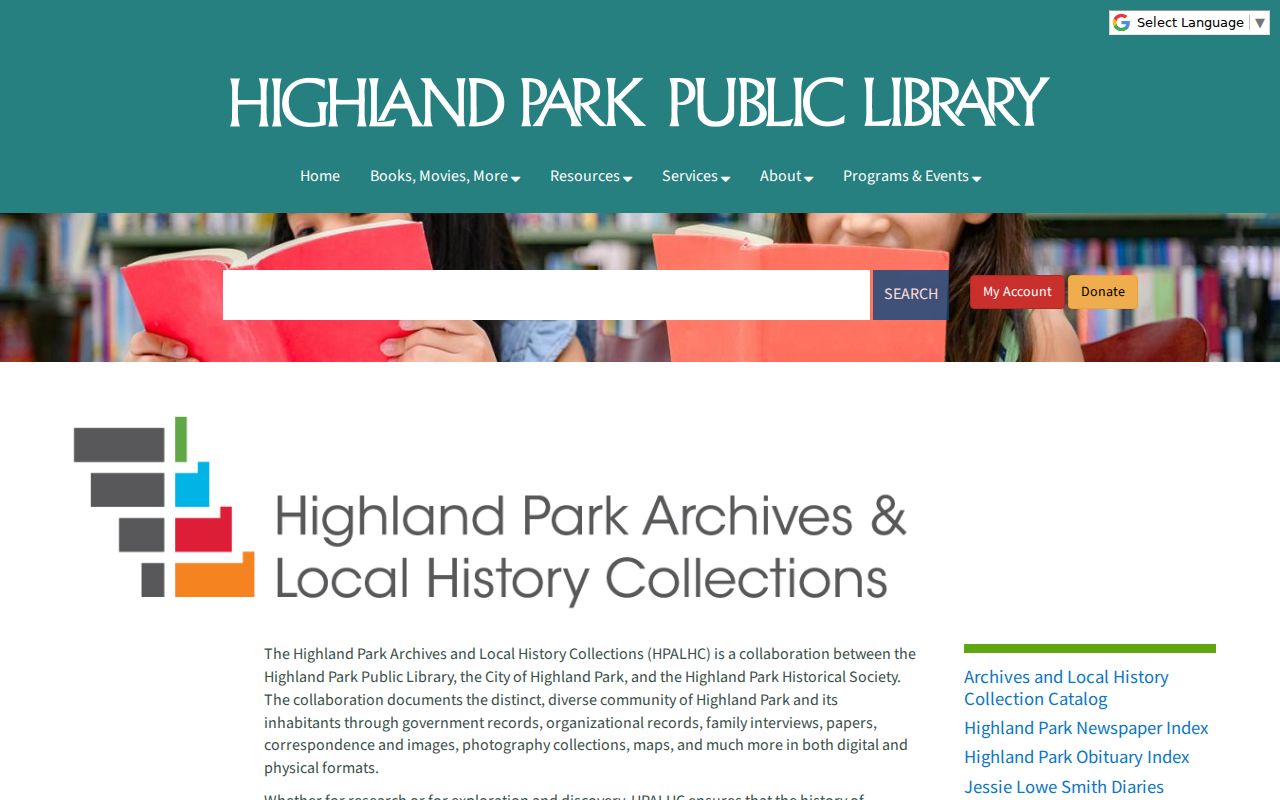
The collection provides the local context needed when a deed index or present address cannot explain an older name.
When Highland Park Records Stop
A dead end often marks a change in access, not the end of the record. An online deed search stops at the modern index and hands off to handwritten books. A court summary may hand off to a courthouse terminal or archived-file request. A vital index may hand off to an eligibility form. An old local name may require the library's obituary scan service or an IRAD request. Highland Park City records not posted online may require a focused request to the department that holds them.
Illinois FOIA, 5 ILCS 140/1 et seq., generally sets a five-business-day response target and allows a statutory extension in qualifying cases. It does not override the Vital Records Act, election rules, court restrictions, sealed records, or the Illinois Address Confidentiality Program. Ask for a named record series, date span, department, and subject. A narrow request is easier to route and less likely to collect private material that does not answer the question.
That fallback chain completes the Highland Park residents directory: portal, source image, counter terminal, mail form, archive request, or lawful records request. Stop when the remaining task becomes a hunt for a protected address or private household detail.