
Highland Park Past Resident Sources
The backward trail changes by era. Modern parcel and deed tools are online, while the oldest previous residents may require handwritten books, local archives, or library-only databases. Start with the source closest to the date in question.
| Source | Years covered | Where held | What it shows |
|---|---|---|---|
| Assessor and parcel GIS | Current roll and mapped data | Lake County assessor and GIS | Owner or taxpayer, PIN, situs, legal text, sale fields |
| Recorded-land index | Online from January 2, 1980 | Lake County Official Records | Grantors, grantees, document dates, deeds and liens |
| Handwritten index books | Before 1980 | Recording Division access | Name-to-book and document references |
| Street directories | Local 1919, 1922, 1951; broader 1901-1925 | HPPL and in-library databases | Occupant, spouse, work, phone, address |
| Telephone collection | 1890-2014; digital 1908-1913 | Library and Historical Society | Listed subscriber and phone address |
| Sanborn maps | 1900, 1907, 1912, 1918, 1924, 1933 | HPPL and Library of Congress | Footprint, material, use, old number |
| House compilation | Compiled 1958 | Moraine Township material cited by HPPL | Owner, age, lot, permits, price, photos |
A date range is not a promise that every Highland Park address appears. The right response to a gap is another access channel, not a guessed resident.
Trace Highland Park Deeds Backward
Begin at the Lake County assessor. Search one primary key, save the PIN, current taxpayer, situs address, legal description, and sale document. Then locate that purchase instrument in Lake County Official Records. The seller on the deed is the grantor; the buyer is the grantee.
- Open the current owner's acquisition deed and confirm the legal description.
- Search the seller as a grantee to find when that person acquired the property.
- Inspect the earlier deed rather than trusting only the index row.
- Repeat, recording every document number, date, party role, and legal description.
- At the 1980 handoff, continue through handwritten grantor and grantee index books.
Old documents may not contain a modern address or PIN. Lot, block, subdivision, and legal-description text are often the bridge. The county explicitly says staff cannot conduct a title search and does not guarantee a complete chain.
- Grantor and grantee
- The party giving an interest and the party receiving it.
- Chain of title
- The ordered series of recorded transfers affecting one parcel.
- Legal description
- The formal land description that can remain stable when a street number changes.
Highland Park Deed Access Channels
The web portal is only the first route. Public terminals are on the sixth floor of the County Building, 18 N County Street, Waukegan, Monday through Friday from 8:30 a.m. to 5 p.m. Terminal searches are free. Copies are generally $1 per page and plats $5 per page. Requests may be made in person, by mail, fax at 847-964-5860, phone at 847-377-2575, or email to recorder@lakecountyil.gov.
The recorder's search and copy information describes these practical routes.
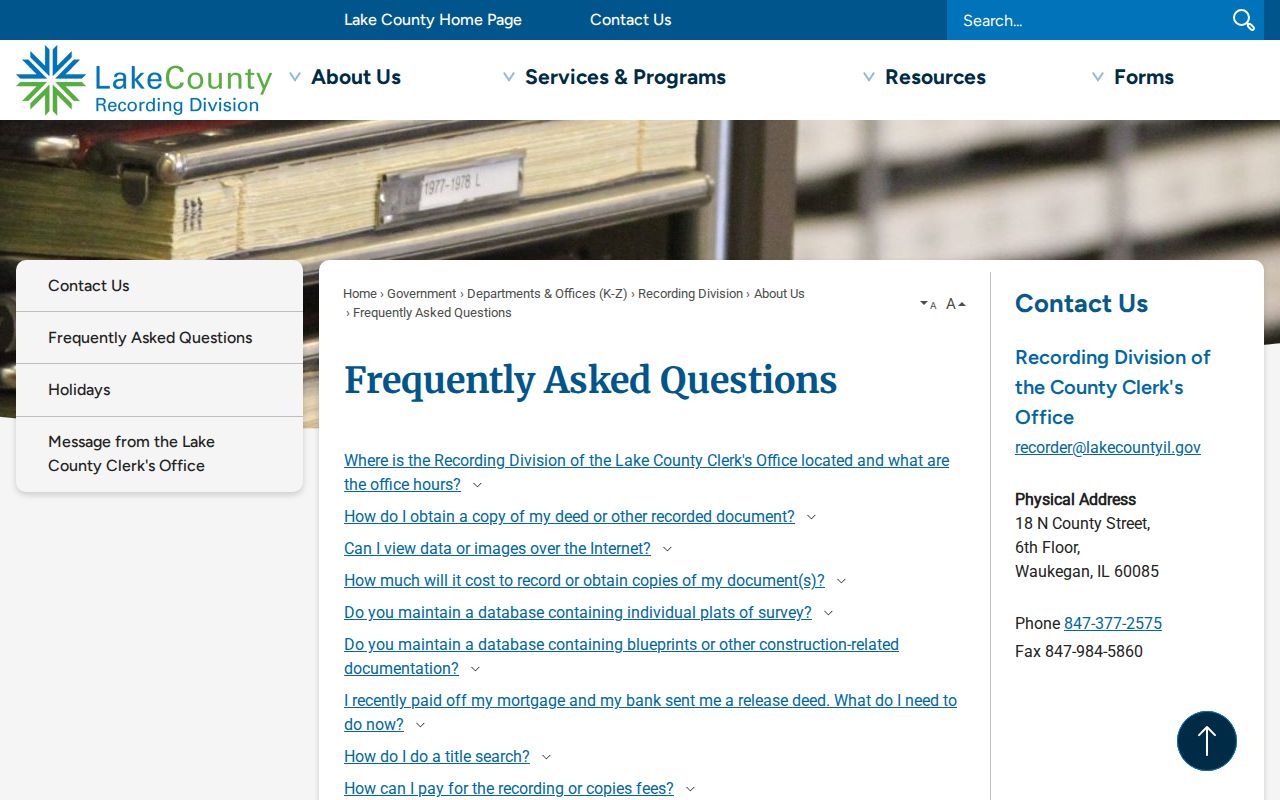
The captured page is especially useful when an online image is absent or a certified copy is needed.
Note: The online cutoff is a handoff to handwritten books, not the beginning of Highland Park land ownership.
Highland Park's Address Continuity Trap
Highland Park renumbered streets in October 1950. Newspaper index entries from 1949 through 1951 document the debate, grid plan, owner notices, and city action. A street-name change from County Line to Sheridan also appears in the 1951 index. Searching only today's number can lose the earlier household.
Create a bridge card with old number, later number, street-name variants, PIN, legal description, and evidence citation. Start with a pre-change directory or Sanborn sheet. Compare the 1951 directory, newspaper references, maps, permits, and the modern parcel. Never convert the numbers with a citywide formula.
The HPPL Research Your Home guide brings the number change and local sources together. This local quirk is one of the most important checks in any previous residents search.
Highland Park Past Household Layers
Ownership is only half of an address history. The 1919 and 1922 local directories are arranged by occupant name and can include a spouse, occupation, telephone, and sometimes a business address. The 1951 book is a useful bridge after renumbering. Broader Waukegan and Evanston directories may capture an early Highland Park entry. The telephone collection spans 1890 to 2014, with 1908 through 1913 digitized.
Pair directory years with federal census schedules under the National Archives' 72-year release rule. The 1950 census is the latest fully released decennial schedule. Check household relationships, spelling, enumeration date, and the city or township boundary for that year. A telephone subscriber is not a complete household roll.
- Record the named occupant and exact printed address.
- Find the closest released census and compare household names.
- Check the next directory year for arrival, departure, or number change.
- Test alternate spellings and nearby Waukegan or Evanston editions.
- Mark any conclusion that rests on one source only.
The historical collections are described in depth on the Highland Park city directory collections page.
Map Former Highland Park Households
Sanborn fire-insurance maps provide a physical checkpoint. Highland Park research materials identify sheets for 1900, 1907, 1912, 1918, 1924, and 1933. They can show a building footprint, construction material, outbuildings, use, and the street number then in force. They do not prove ownership or occupancy.
Compare the sheet with the legal description and a dated directory entry. A changed footprint may explain why a later permit appears. A demolished or rebuilt structure also warns against assuming that every person tied to the parcel lived in the same building.
The 1958 Moraine Township house compilation adds another layer. The library guide says it may include owner, house age, lot size, physical description, purchase price, permits, and photographs. It was not located as a complete public web database, so ask local-history staff rather than inventing an online search.
Highland Park Permits Mark Change
The City permit inquiry accepts a parcel address, owner or applicant surname, date range, type, and status. A permit can date an addition, demolition, or repair and may preserve a name supplied with the project. Older building files cited by the library reach into the late 1920s.
A permit does not prove that the named applicant or owner occupied the home. Place it beside a deed, directory, census entry, or newspaper notice. The modern PIN and legal description help ensure the permit belongs to the same land despite a number change.
Highland Park Resident Trail Endpoints
Obituaries, probate, and later deeds can explain where a household trail ends. The Highland Park obituary index covers several local papers, generally from 1874 through 2009. A researcher can identify the paper, date, and page, then request a scan by email, fax, or USPS. The library states no charge and limits requests to six scans per month.
Probate files belong with the Lake County Circuit Clerk, not the county recorder. Search the docket, note the person's role, and follow any public estate deed back to Official Records. Court restrictions still apply. A death certificate is not generally public; access requires the qualifying interest or authorization described by Illinois law and county policy.
The county's genealogical records route addresses older birth and death searches.
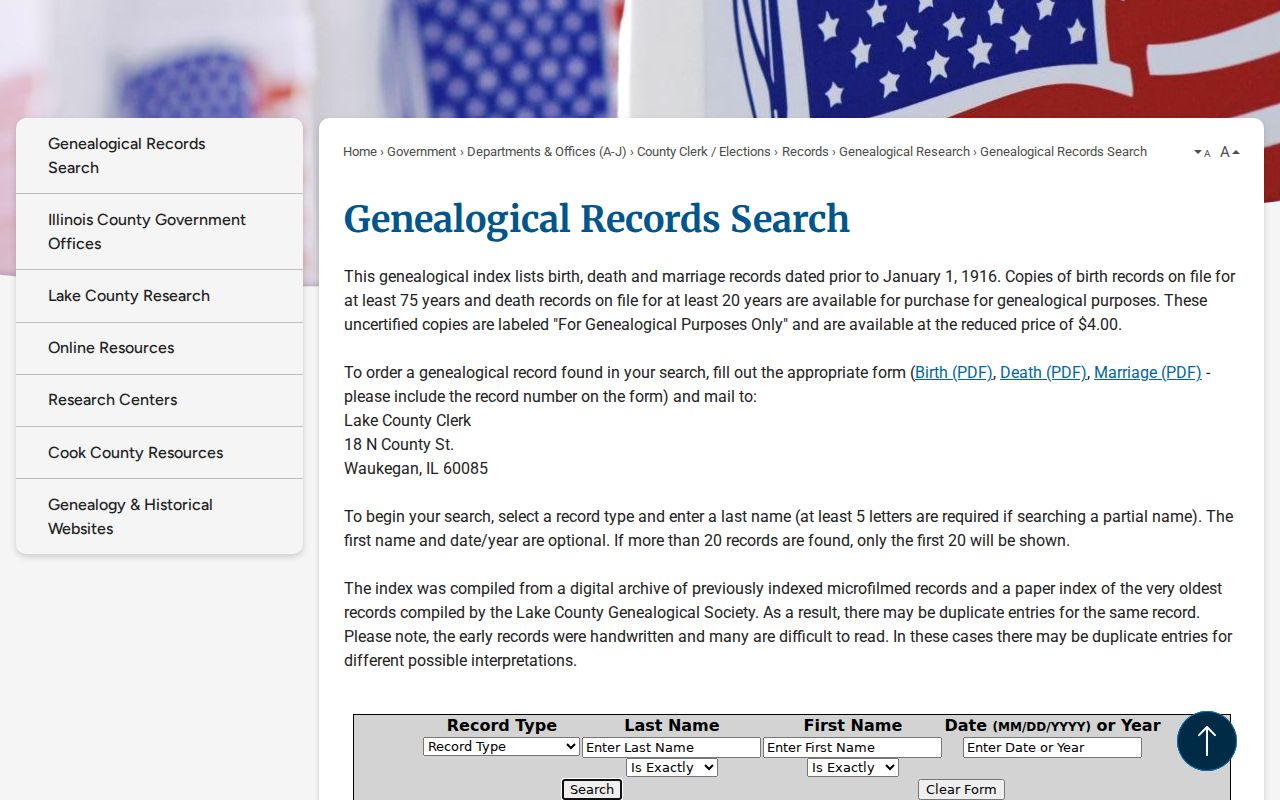
The page shows why an index search and an eligible certified record request are different steps.
Highland Park Archives Fill Gaps
Highland Park Archives & Local History Collections holds maps, photographs, family interviews, papers, correspondence, and government or organization records from the 1800s onward. The newspaper index starts with Highland Park News in 1874 and extends through 2010 index pages. Full text covers 1874 through 1922, with later material on microfilm.
For a previous residents packet, preserve a current assessor card, a post-1980 recorder result, the pre-1980 handwritten-index citation, a directory or permit near 1951, and one Sanborn sheet. This four-era set makes clear what changed and what remains uncertain. If county material is older still, Illinois Regional Archives Depository holdings include Lake County court, birth, deed, probate, and poll-book series, with access depending on the record.
Note: Local history context should be paired with a dated primary image, deed, directory page, map, or case entry.
Limits on Highland Park Past Residents
Previous residents research serves house history, genealogy, estate work, and personal curiosity. It should distinguish a recorded owner, taxpayer, directory subscriber, census household member, and permit applicant. These roles are not interchangeable. A blank year or missing name is uncertainty, not evidence that no one lived there.
Living people may have protected addresses, and private household or utility data is not opened by a historical question. Use public indexes to document the property, not to pursue someone's present private location.
Lawful use. Trace Highland Park homes with care and respect. Never use past resident records to stalk, harass, intimidate, or harm a living person.